The Boarding Axe
By: Noel Wells
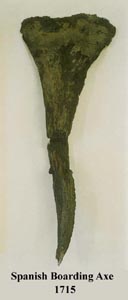 |
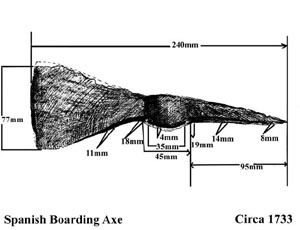
The boarding axe found by Captain John Curiale of the
salvage vessel, "Romans Eight", during the 1999 dive season is an
excellent example of rare Spanish weaponry. Although most boarding axes
appear much the same, there are small differences in the construction of
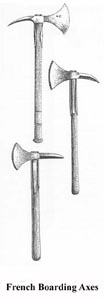
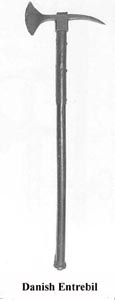
each. Each naval power seems to have its own distinctively shaped axe. The
English boarding axe differs from the Danish, and the Danish from the
French. The Spanish axe has a more streamlined shape than the rest. This
axe is in good condition with the only significant loss of metal occurring
at the point where the axe handle enters the head of the axe. This axe
should compare with some of the best examples recovered from a Spanish
shipwreck. |
 |
 |
Weapon and tool, the axe was carried to sea by sailors
in time before memory, and there has remained into present as the ships
fire axe. Accordingly axes were known by many names. By the time of the
American Revolution, they were noted in ships manifests, armory receipts,
ordinance lists as battle axe, pole axes, sometimes simply axes, or
hatchets. ’’The axe was carried by boarders and used to damage the enemy’s
ship, cut up his rigging, hack through a spar and smash through a
bulkhead. It was a weapon of destruction, but, of course, still basically
an axe with a spike at the back. It was also useful in emergencies for
cutting away ropes or spars which threatened to endanger the ship".
(Dictionary of Tools, used in the woodworking and allied
trades, Ca.1700 1970, R.A. Salaman, Pg49). During the French and
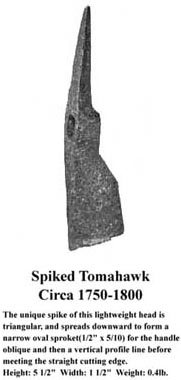
Indian war and well into the American Revolution, The Spiked Poll,
or Spiked Axe was in use in North America by the colonists and
seems to have been especially popular with the Iroquois Indians. The
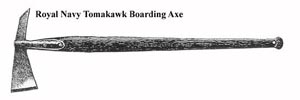
resemblance between this spiked tomahawk, and the boarding axe is notable.
The tomahawk is smaller and lighter, but the overall shape is remarkably
similar. "Although a lethal weapon and useful tool the spiked tomahawk was
dangerous and uncomfortable to carry". (Swords and Blades of the
American Revolution, George C. Neumann, Promontory Press.Pg259).
|
By whatever name, or for whatever navy, the boarding axes work
was the same. The boarding axe’s distinguishing characteristics was of a pick
head opposing an axe head. From earliest times, fire aboard ship was one of the
deadliest perils imaginable. Because of their mass, hot shot was impossible to
extinguish even by repeated sloshings with water. If a ship came under fire from
a shore fortification there was the danger of furnace-heated cannonballs
striking the timbers or masts and becoming embedded. The only way to deal with
them was to hack and pick them free. Their value as a fire tool alone would
insure a place aboard wooden warships, but because of their versatility they had
other uses that were equally important.
As various forms of dismantling shot came into use; masts and
rigging were commonly shot down, putting the ship at risk. With masts, spars and
tons of other debris laying on deck and dragging alongside, the vessel could not
maneuver to fight or flee, making her an easy target, certain to be boarded or
simply pounded to rubble by an opponent lying off at a distance. The boarding
axe was the tool used to clear the decks of twisted lines and broken timbers.
The hook of the axe was used to drag debris across the decks and over the side
while the axe head was, of course, the cutting edge. The sloping shape of the
blade underbelly made it useful as a rope hook also. The evolution of the battle
axe’s role as an emergency shipboard tool alone guaranteed its retention in the
worlds navies.
As a weapon the boarding axe continued to be listed in naval
inventories mostly as a backup weapon for that portion of the crew not
designated as boarders. If facing enemy boarders, the boarding axe provided the
crew with a ready arms reserve. There are references to its having been issued
to boat parties. "It was to be cutlasses and tomahawks". Captain Preble
reporting on Decatur’s night attack on the frigate Philadelphia in
Tripoli harbor. (Preble to Tobias Lear, U.S.Consul General at Algiers Feb.19,
1804. A Most Fortunate Ship pg.56.Tyrone G Martin Captain, U.S.S.
Constitution). By 1747 Mountaine’s The Practical Sea Gunners
Companion lists under gunners stores: "the number of pole axes, well steeled
issued being 50 to ships of 100,90,80 and 64 guns; and 20 to 20 gun ships".
(Boarders Away. Wm. Gilkerson pg.30 Vol. 1.Published by Andrew Mobray, Inc.
Old Louisquisset Pike, Lincoln R.I.).With a handle length of between
15 and 33 inches and sometimes equipped with a lanyard at the end, it could
deliver a nasty, and no doubt, fatal blow-a weapon to be greatly
feared.
 As is the case
with so many utilitarian items, what was once common is now scarce. Today there
are so few left in existence that the boarding axe is one of the rarest weapons
of naval warfare. A simple tool, not very useful ashore, the boarding axe is
a tool of the sea. Of all the European powers, Spain was by far the most conservative
in regards to its weapons. While the Spanish navy was very important to the
maintenance of the colonies, its weaponry was as obsolete as its organization.
As an example of this, the 1733 Spanish fleet carried matchlock muskets. This
was almost 100 years after the other navies changed to flintlock muskets. In
all of Madrid’s Naval museum, one can scarcely find a small arm of naval origin
from this period of study. Because of this disregard for naval weapons, as the
older weapons were used up they were discarded. They may or may not have been
replaced. If a new model or type was issued, the army was sure to get it first
and the now, obsolete styles were foisted on the navy. The boarding axe being
strictly a naval weapon would have been among the last tools or weapons on the
list of priorities scheduled for replacement.
As is the case
with so many utilitarian items, what was once common is now scarce. Today there
are so few left in existence that the boarding axe is one of the rarest weapons
of naval warfare. A simple tool, not very useful ashore, the boarding axe is
a tool of the sea. Of all the European powers, Spain was by far the most conservative
in regards to its weapons. While the Spanish navy was very important to the
maintenance of the colonies, its weaponry was as obsolete as its organization.
As an example of this, the 1733 Spanish fleet carried matchlock muskets. This
was almost 100 years after the other navies changed to flintlock muskets. In
all of Madrid’s Naval museum, one can scarcely find a small arm of naval origin
from this period of study. Because of this disregard for naval weapons, as the
older weapons were used up they were discarded. They may or may not have been
replaced. If a new model or type was issued, the army was sure to get it first
and the now, obsolete styles were foisted on the navy. The boarding axe being
strictly a naval weapon would have been among the last tools or weapons on the
list of priorities scheduled for replacement.
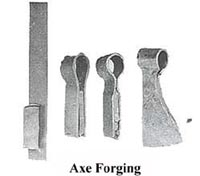
Our example has only a socketed head and no langets, or side
straps. The langets proved to be a very secure system for attaching the handle.
The langets also provided protection for the wooden handle. The axe that we
are dealing with would likely have had a wedge driven into handle at the socket
like a modern-day hammer. The wedge has always provided a tight fit and was
probably used with the langet-equipped axes as well. There is no belt hook remaining
and if there was one, it was fitted under the socket head attached to handle,
and not integral to the forged piece. The wood used for the handle was likely
to be oak, ash, or any tough, straight -grained hardwood.
In the collection of axes held by the Florida Archaeological
Research Department it can be seen that of the two dozen or so, roughly half are
marked. One axe has an asterisk chiseled into the right side, and comes from the
1715 fleet. Another having a single asterisk is estimated to have been made in
1618One example, dating to 1622, shows four "X’’s, each inside of a recessed
circle. A mortising axe, circa 1700,has the marks "H 3", imprinted twice, each
within a recessed rectangle. Only two, or perhaps three of these marked axes are
boarding axe, the remainder being more of the pole axe style, with the exception
of the mortising axe. (Drawings from the State of Florida’s Laboratory
Artifact Processing Records, provided by James Levy, Conservator.) Of the
shipwreck salvaged axes in the State of Florida’s collection, the one that most
closely resembles our example was recovered from the 1733 fleet in 1975.It has
the same streamlined shape and no langets. The spike end on the 1733 head is
almost straight and our axe hook has the more commonly seen downward curve.
There are no markings on this recently recovered axe head, and it was, of
course, hand forged from iron.
While there are few weapons of this type remaining today, our
problem is, there are far fewer Spanish weapons than types from any other
significant sea power. This makes the positive identification of this artifact
as a Spanish weapon/tool more difficult. Fortunately we are able to compare and
see that the 1733 example mentioned above is a very close match. When one
considers that both of these axes were recovered from Spanish wrecksites we
could, with reasonable assurance, conclude that they are both Spanish artifacts.
Conserving this piece will be a straightforward process of electrolytic
reduction until the salts are driven out and piece is stabilized. It will then
be lightly bead-blasted and treated with Incralac to further preserve
it.
Click To Return To The
Conservation Index