| Note:
This article has a LOT of good pic's to download, but it
is well worth the time!!
|
STONE AGE HAND-AXES
by W.J. Kowalski
    
1.
 There were no handaxes at the beginning of the Pleistocene,
and none at the end, but for one million years in between
this was the tool of choice for stone age man. Although everpresent
in stone age culture, the exact purpose and use of this tool
remains a mystery. There were no handaxes at the beginning of the Pleistocene,
and none at the end, but for one million years in between
this was the tool of choice for stone age man. Although everpresent
in stone age culture, the exact purpose and use of this tool
remains a mystery.
The
Pleistocene lasted from two million years ago to the present.,
which is called the Holocene. At the beginning of the Pleistocene
primitive man was already using fire and making stone, bone,
and wooden tools. He wore animal skins scraped clean with
stone scrapers, cut in straight lines and stitched together
with leather laces.
The
reason handaxes seem to have no specific purpose is probably
because they served a general purpose. They could could
be used for cutting meat, scraping skins, chopping wood,
digging holes, hammering bone or wood, and perhaps as a
last resort defense against wild animals -- perhaps sort
of a Stone Age Swiss army knife. The proliferation and abundance
of handaxes suggests that perhaps everyone had one. As techniques
for making handaxes slowly improved over the millennia,
these same techniques would have led to new types of specialized
tools, ultimately making the handaxe obsolete.
 The handaxe appears almost everywhere that early man
appears (see image at left), with the exception of the very
far east. Ultimately the handaxe was replaced by an array
of specialized tools, and may have ceased to have any value
beyond that of pure tradition and culture. Perhaps every
boy who came of age was given his own handaxe, or perhaps
they came to have only ritualistic use. Some late handaxes
were excellently manufactured, but seemed to receive little
actual use. A number have been found that were deliberately
driven point first into the ground and left, for unknown
reasons. The handaxe appears almost everywhere that early man
appears (see image at left), with the exception of the very
far east. Ultimately the handaxe was replaced by an array
of specialized tools, and may have ceased to have any value
beyond that of pure tradition and culture. Perhaps every
boy who came of age was given his own handaxe, or perhaps
they came to have only ritualistic use. Some late handaxes
were excellently manufactured, but seemed to receive little
actual use. A number have been found that were deliberately
driven point first into the ground and left, for unknown
reasons.
 Handaxes come in many shapes and sizes, and many styles
unique to cultures of specific periods and in specific geographical
areas. Almost all handaxes have a point, are sized for the
hand and shaped to be held. Almost no handaxes have notches
for mounting. Attempts to dramatize Stone Age man as a crude
and warlike savage often show handaxes mounted as oversized
spearpoints. Such comic personification says more about
our violent modern culture than it does about this pristine
world of teenage hunters (average age 19) who spent their
time on beaches and riverbanks. They rarely lived beyond
the age of 35, not because of hardship, but more probably
because of disease, since even minor cuts could cause fatal
infections. Handaxes come in many shapes and sizes, and many styles
unique to cultures of specific periods and in specific geographical
areas. Almost all handaxes have a point, are sized for the
hand and shaped to be held. Almost no handaxes have notches
for mounting. Attempts to dramatize Stone Age man as a crude
and warlike savage often show handaxes mounted as oversized
spearpoints. Such comic personification says more about
our violent modern culture than it does about this pristine
world of teenage hunters (average age 19) who spent their
time on beaches and riverbanks. They rarely lived beyond
the age of 35, not because of hardship, but more probably
because of disease, since even minor cuts could cause fatal
infections.
 These youthful cavepeople made fine stone tools, works
of art, and spears and arrows for hunting, but they made
no weapons for killing other humans until about 26,000 BCE,
perhaps when leaders (older males?) became predominant.
The hunters of the stone age enjoyed abundant game during
warmer climates, hunting many species to extinction. They
had the time to create the most excellent stonework and
wall paintings, circa 100,000 - 20,000 BCE. It has been
noted before that the quality of stone age art has not been
exceeded today -- only our technology has improved. These youthful cavepeople made fine stone tools, works
of art, and spears and arrows for hunting, but they made
no weapons for killing other humans until about 26,000 BCE,
perhaps when leaders (older males?) became predominant.
The hunters of the stone age enjoyed abundant game during
warmer climates, hunting many species to extinction. They
had the time to create the most excellent stonework and
wall paintings, circa 100,000 - 20,000 BCE. It has been
noted before that the quality of stone age art has not been
exceeded today -- only our technology has improved.
|
2.
At
the right is an early chopper from about 2,000,000 BCE. Chopper
industries preceded handaxes but led directly to them as tool-making
methods evolved. Choppers, also an all-purpose tool, were the
first stone tools to be made rather than 'found'.


|
Acheulean
Handaxes from Saint-Acheul, France. Dated to the Lower
Paleolithic, Riss glaciation, or approximately 1,000,000
to 300,000 BCE. |
 |
Primitive
Abbevillian handaxe from Olduvai, approximately 1,000,000
BCE. |


 |
Acheulean
handaxes from Sbaika, Algeria. Made by homo erectus. Dated
to the Riss glaciation. |

 |
Crude
Acheulean handaxes from Sbaika, Algeria. From about 1,000,000
to 500,000 BCE. |

 |
Crude
handaxe from Abbevillian culture. Found in Abbeville,
France. Perhaps from 1,000,000 to 500,000 BCE. |
 |
Large
Padjitanian handaxe from Java. About 750,000 BCE. |

 |
Almond
shaped handaxes from the Late Acheulean. Found near St.
Acheul, France. Perhaps from about 300,000 to 100,000
BCE. |

 |
Upper
Acheulean handaxes from Kalambo Falls, northern Rhodesia.
Approximately 100,000 to 200,00 BCE. |
 |
Small
Micoquian handaxes from La Micoque, France. From 100,000
BCE. |
 |
Medium
sized Micoquian handaxes from La Micoque, France. From
100,000 BCE. |
 |
Large
Micoquian handaxes from La Micoque, France. From 100,000
BCE. |
 |
Small
handaxe made from rock crystal. Late Mousterian, about
100,000 BCE. From Kulna cave, Moravia. |

 |
Small
handaxes. Late Mousterian, about 100,000 BCE. From Kulna
cave, Moravia. |

 |
Upper
Acheulean handaxes from Isimila, Tanzania. From about
100,000 BCE. |
 |
Mousterian
handaxe from Kulna cave, Moravia, Czechoslovakia. |
 |
Giant
Acheulean handaxe from Norfolk, England, over 6" long
and 2.5 inches wide. Most handaxes were only 10 cm long,
but then Homo habilis and erectus were only about 4 feet
tall. |
 |
Larger,
more evolved Abbevillian handaxes from Olduvai, Africa.
Approximately 500,000 BCE. |

 |
Small,
crudely struck handaxes from Swanscombe, Kent, found in
the middle gravels. Acheulean, perhaps 500,000 BCE. |
| |
|

 |
Pointed
Clactonian handaxes from Swanscombe, Kent, England. This
fine workmanship by a tool-making Neanderthal was noted
by J.J. Wymer, who was also British. |
 |
Subtriangular
Mousterian handaxe, about 500,000 BCE. |
 |
Triangular
Mousterian handaxe, about 500,000 BCE. |
 |
Cordate
Mousterian handaxe, about 500,000 BCE. |
 |
Acheulean
cordate handaxe made of silcrete. From Elandsfontein,
Cape Province, South Africa. Middle Pleistocene, 500,000
BCE. |
 |
Middle
Acheulean handaxe from Swanscombe. About 300,000 - 500,000
BCE. |
 |
Elegant
cordate handaxe from Hoxne, Suffolk, England. Late Aceulean,
about 350,000 BCE. |
 |
Three
views of a backed handaxe from the Upper Acheulean, approximately
200,000 to 100,000 BCE. |
 |
Ovate
Aceulean handaxe from about 200,000 BCE. Found in the
dunes near Abbeville, France. |
 |
Small
Mousterian handaxe of Acheulean tradition. From Pech del'Aze.
About 100,000 BCE. |
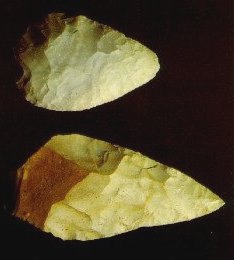 |
Handaxes
from Perigord, France. The lower handaxe still has its
point intact. Mousterian period. From the Perigord Museum. |
 |
Large
handaxe of the Mousterian period. From the Perigord Museum. |
 |
Ovoid
Mousterian handaxe. From the Perigord Museum. |
 |
Mousterian
handaxe from Volgogrod, Russia. About 80,000 BCE. |
 |
Mousterian
Cordiform handaxe of Mousterian tradition. From the beginning
of the Wurm glaciation, about 70,000 BCE. Note the increased
attention to detail. |
 |
East
Gravettian (Pavlovian) handaxe from Dolni Vestonice, Czechoslovakia.
From about 30,000 BCE. |
 |
Two
views of a specialized type of late handaxe called a Prodnik,
which was a sort of bifacial knife. From Wylotne, Poland,
Middle Paleolithic (Wurm II) about 50,000 -30,000 BCE.
Later prodniks specialized further and became different
tools, while handaxes themselves became rare and then
disappeared. |
 |
An
advanced, or 'perfected', handaxe from the late Mousterian
or Early Aurignacian (Perigordian). perhaps 50,000 - 35,000
BCE. From the Perigord Museum. |
 |
Triangular
handaxes of the perfected variety, Early Aurignacian.
If the dating is correct, these are among the last handaxes
that were made before the final diversification and specialization
of fine stone tools made the handaxe obsolete. |
| |
|
|
|
